You Weren’t Trained for Entrepreneurship and That’s Not a Flaw
Jan 14, 2026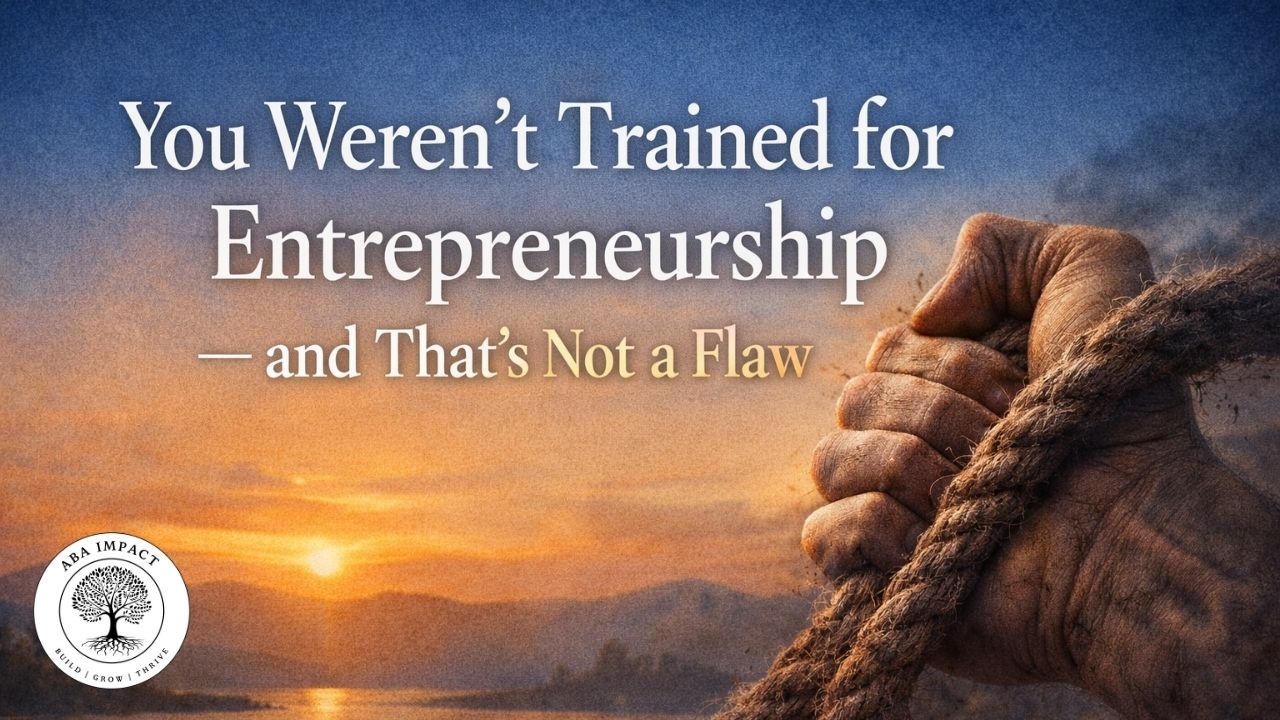
You Weren’t Trained for Entrepreneurship and That’s Not a Flaw
There’s a quiet thought many ABA founders carry, especially in the first few years.
It usually shows up late at night, or after one too many hard decisions:
“Maybe I’m just not cut out for this.”
Not said out loud.
Not shared with staff.
Often not even shared with peers.
Just internalized.
The assumption underneath that thought is powerful… and damaging:
If entrepreneurship were right for me, this wouldn’t feel so hard.
But that assumption is wrong.
Not because entrepreneurship is easy.
And not because you’re secretly doing it wrong.
It’s wrong because you were never trained for this part.
And lack of training is not a character flaw.
The Silent Assumption Founders Carry
Most ABA founders don’t start businesses because they dream of being entrepreneurs.
They start because:
- They wanted autonomy
- They wanted to practice ethically
- They saw gaps in care
- They were good clinicians who were trusted to lead
Somewhere along the way, ownership became the path of least resistance.
And then the weight showed up.
Suddenly, you’re expected to make decisions that don’t feel clinical at all:
- Hiring before you feel ready
- Spending money before it comes in
- Leading people when you don’t have certainty
- Choosing between “bad” and “less bad” options
That’s when the silent assumption creeps in:
“Maybe other people are just built for this.”
“Maybe I’m too cautious / too anxious / too thoughtful.”
“Maybe I’m missing whatever entrepreneurs are supposed to have.”
That story feels personal, but it’s actually structural.
Because ABA training does an excellent job preparing you for one type of decision-making.
Entrepreneurship requires a completely different one.
What ABA Training Actually Prepares You For
ABA training is rigorous, disciplined, and evidence-driven for good reason.
You were trained to:
- Assess behavior carefully before intervening
- Look for patterns, not anecdotes
- Make decisions based on data, not impulse
- Adjust plans thoughtfully over time
- Minimize risk to vulnerable clients
You were taught to value:
- Accuracy
- Replicability
- Ethical restraint
- Measured progress
In clinical work, waiting for good information is responsible.
In entrepreneurship, waiting often is the risk.
That doesn’t mean your training failed you.
It means it prepared you for excellence in a different system.
What Entrepreneurship Requires Instead
Entrepreneurship runs on a different set of demands… ones most clinicians were never taught explicitly.
It requires:
Risk tolerance without certainty
You rarely get perfect data.
You make decisions knowing some variables won’t reveal themselves until later.
Action under incomplete information
You move forward based on patterns, probabilities, and timing, not clinical confidence.
Financial timing awareness
Cash flow doesn’t behave like outcomes.
Money you’ve “earned” may not exist yet.
Delays don’t mean failure, but they feel like it if you weren’t prepared.
Leadership without emotional containment
You’re expected to project steadiness even while learning in real time.
None of this is intuitive to clinicians.
And none of it is about personality.
It’s about training.
The Muscle Model
Here’s the reframe most founders never hear early enough:
Entrepreneurship is not a personality trait.
It’s a set of muscles.
Muscles feel weak before they get strong.
Not because something is wrong with you, but because they’re being asked to do something new.
Struggle here doesn’t mean:
- You’re not capable
- You’re not smart enough
- You’re “bad at business”
It means you’re using muscles you weren’t trained to use yet.
This model matters because it changes the story founders tell themselves.
Instead of:
“Why is this so hard for me?”
The question becomes:
“What haven’t I been trained for yet?”
That shift removes shame without minimizing reality.
It doesn’t make entrepreneurship easy.
It makes it learnable.
Why This Reframe Matters
When founders believe difficulty means deficiency, they do dangerous things:
- They overwork instead of re-skill
- They avoid decisions instead of learning frameworks
- They chase confidence instead of building competence
- They internalize strain instead of contextualizing it
But when difficulty is understood as muscle fatigue, not identity failure, something changes.
Founders stop questioning who they are and start focusing on what they need.
That’s where stability actually begins.
You don’t need a different personality.
You don’t need to become more aggressive, more confident, or more “entrepreneurial” in some abstract sense.
You need different training.
Training that acknowledges:
- uncertainty as normal
- timing as teachable
- leadership as a learned practice
- business as a system, not a test of worth
This month, we’re focused on helping founders stop questioning their identity and start building the skills that make businesses survivable.
Not through hustle.
Not through hype.
And not by pretending this is easy.
Just through clarity, sequencing, and learning the muscles you were never given the chance to train.
This week, we’ll talk about how those muscles actually get built without burning out or pretending entrepreneurship should feel natural.
Join the ABA Founders program for free here: https://ebcba.abaimpact.com/ebcba-blueprint-foundation
Click here to join the eBCBA™ Odyssey and reclaim your role as the visionary leader you’re meant to be.
Stay connected with news and updates!
Join our mailing list to receive the latest news and updates from our team.
Don't worry, your information will not be shared.
We hate SPAM. We will never sell your information, for any reason.