Why 200 ABA Businesses Launch Every Month — and Why 10% Don’t Survive Year One
Jan 05, 2026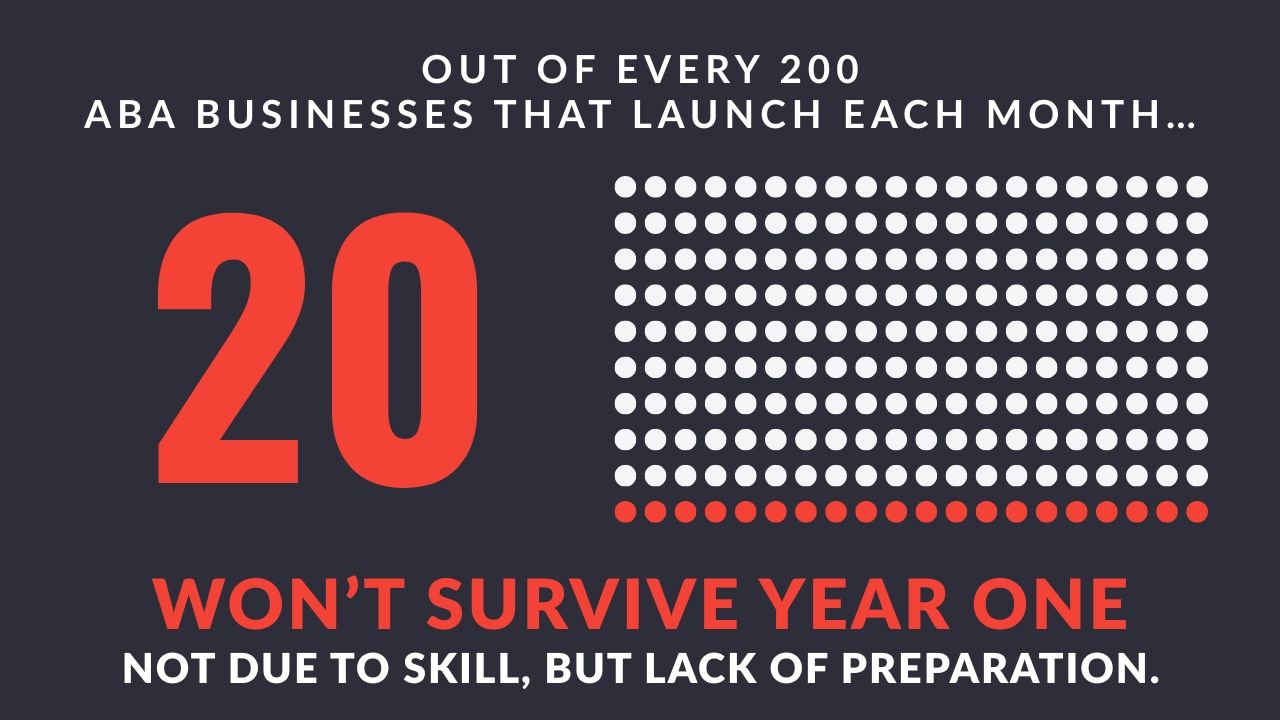
Why 200 ABA Businesses Launch Every Month — and Why 10% Don’t Survive Year One
Every month, roughly 200 new ABA businesses launch.
That number surprises people. It shouldn’t.
The demand for services is real. The clinician-to-founder pipeline is full. And for many BCBAs, starting a practice feels like the most ethical next step: more control over care quality, better outcomes for families, and relief from broken systems they didn’t design.
And yet, every year, a portion of those businesses don’t make it through year one.
Not because the clinicians were unskilled.
Not because the care was unnecessary.
And not because the founders didn’t work hard enough.
The pattern is quieter and far more instructive than panic-driven narratives would suggest.
The Pattern (Not the Panic)
Consistent monthly launches tell us something important: ABA founders are not reckless. They are responding to real demand, real burnout, and real gaps in care.
What often gets misinterpreted is why some first-year practices struggle.
Survivability in year one has very little to do with clinical competence. In fact, many of the practices that close provided excellent care. The issue is rarely “ability.”
It’s sequencing.
Clinical skill and business survivability are two different skill sets. One is taught. The other is often learned under pressure - if it’s learned at all.
When founders assume that strong clinical judgment will naturally translate into business stability, they’re not naïve. They’re following the only model they’ve been shown.
Why Good Clinicians Struggle as Founders
The first year of an ABA business isn’t difficult because founders are unprepared intellectually. It’s difficult because the systemic realities of healthcare entrepreneurship are rarely explained early.
A few of the most common pressure points show up again and again.
Medicaid lag.
Reimbursement delays create a cash flow gap that surprises even cautious founders. Revenue earned is not revenue received and that timing mismatch alone can destabilize an otherwise healthy practice.
Cash flow timing.
Payroll, supervision costs, software, insurance, and rent don’t wait for claims to process. Without clear cash reserves or forecasting, founders find themselves making reactive decisions just to keep up.
Decision overload.
In the absence of systems, every issue routes to the founder. Hiring, scheduling, billing questions, parent communication, vendor choices none of these are “hard” individually. Together, they create a cognitive load that erodes judgment over time.
None of this means a founder did something wrong.
It means they were never trained in survivability.
What First-Year Failure Actually Looks Like
First-year failure rarely looks like sudden collapse.
It looks like quiet erosion.
A founder stops paying themselves to cover payroll.
They delay investments “just until next month.”
They absorb stress, so staff and families don’t feel it.
They operate in constant catch-up mode.
From the outside, the business looks functional. Inside, margins shrink, energy drains, and decisions become reactive.
Eventually, the question isn’t “Can this grow?”
It’s “Can this continue?”
When a practice closes in year one, it’s often not because care wasn’t working but because the business was never given the structure it needed to hold that care safely.
And the real cost isn’t abstract.
When early-stage businesses close, families don’t just lose a provider. Children are sent back onto waitlists. Continuity of care is disrupted. Trust is strained not because anyone failed ethically, but because survivability wasn’t addressed early enough.
Preparation as Ethical Leadership
Preparation is often framed as pessimism.
It shouldn’t be.
In healthcare, preparation is ethical leadership.
Preparing for cash flow timing protects staff from sudden instability.
Preparing for decision load protects founders from burnout.
Preparing systems early protects families from disruption.
Ethical leadership isn’t just about how care is delivered it’s about whether that care can be sustained.
Founders don’t owe the system heroics. They owe themselves clarity.
When survivability is treated as a skill instead of a personality trait, something shifts. Preparation becomes an act of care not fear.
What We Built (Free, On Purpose)
We saw this pattern repeat too many times to ignore.
So, we built a Foundation course for early-stage ABA founders for free – intentionally and without upsell pressure.
Not to scare anyone.
Not to sell complexity.
And not to turn founders into business experts overnight.
The goal is orientation.
The Foundation course walks through what actually matters in year one:
- Cash flow timing and reality
- Common survivability traps
- Decision sequencing
- Founder load and capacity
It’s not a replacement for experience. It’s a map so experience doesn’t have to be learned the hardest way possible.
There’s no urgency attached. No countdowns. No “act now” language.
Because clarity works best before pressure shows up.
What You Should Do Next in Preparation
The fact that 200 ABA businesses launch every month is not a problem.
It’s evidence of commitment, demand, and care.
The fact that some don’t survive year one isn’t a moral failure. It’s a training gap.
Survivability is a skill.
Preparation is leadership.
And clarity early is kindness to your future self.
Get access to the free Foundation course → https://ebcba.abaimpact.com/ebcba-blueprint-foundation
Click here to join the eBCBA™ Odyssey and reclaim your role as the visionary leader you’re meant to be.
Stay connected with news and updates!
Join our mailing list to receive the latest news and updates from our team.
Don't worry, your information will not be shared.
We hate SPAM. We will never sell your information, for any reason.